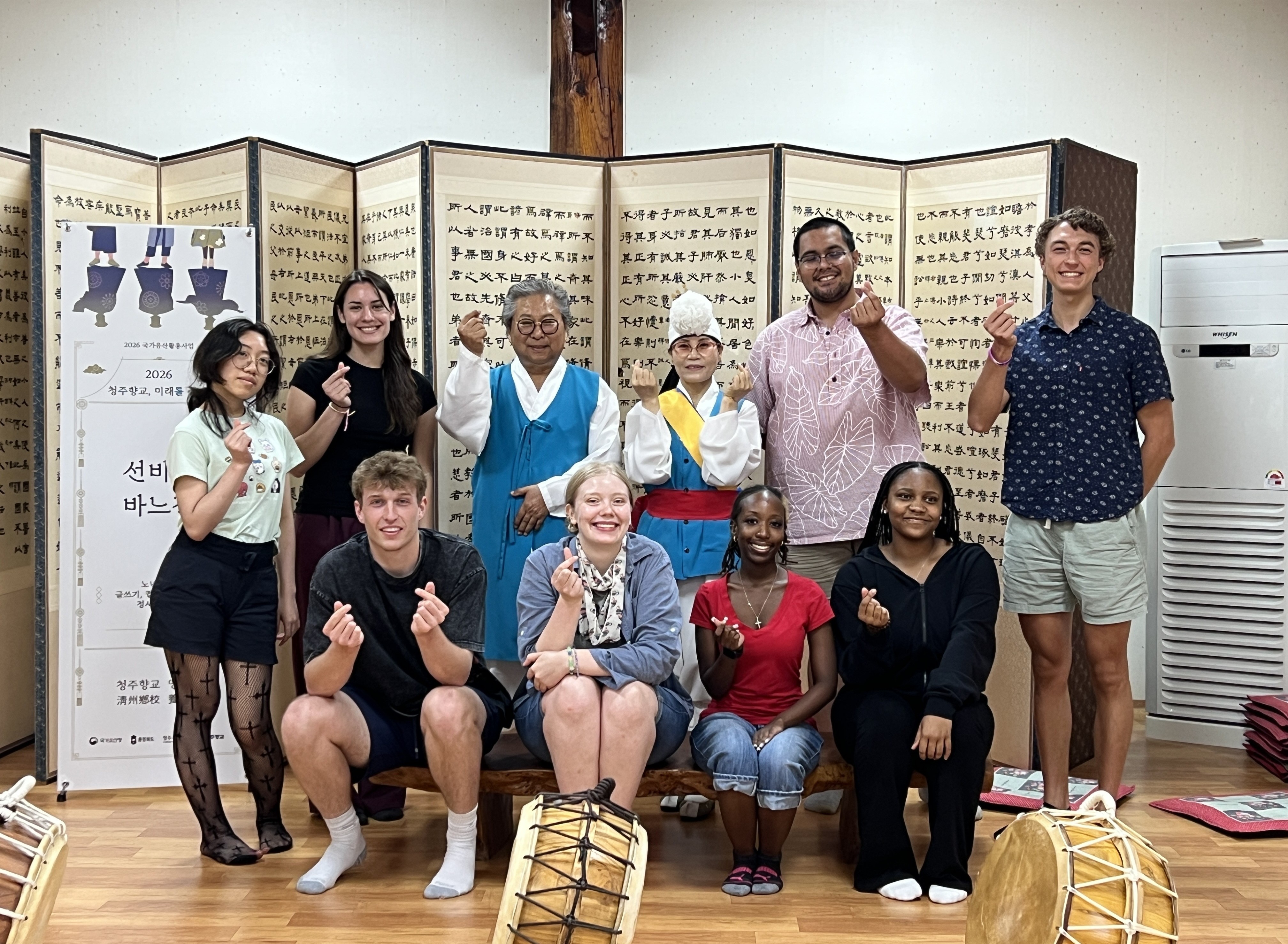
Participants in American Councils Study & Research Abroad’s 2026 summer language programs in Taiwan and South Korea achieved the strongest speaking proficiency gains in each program’s history.
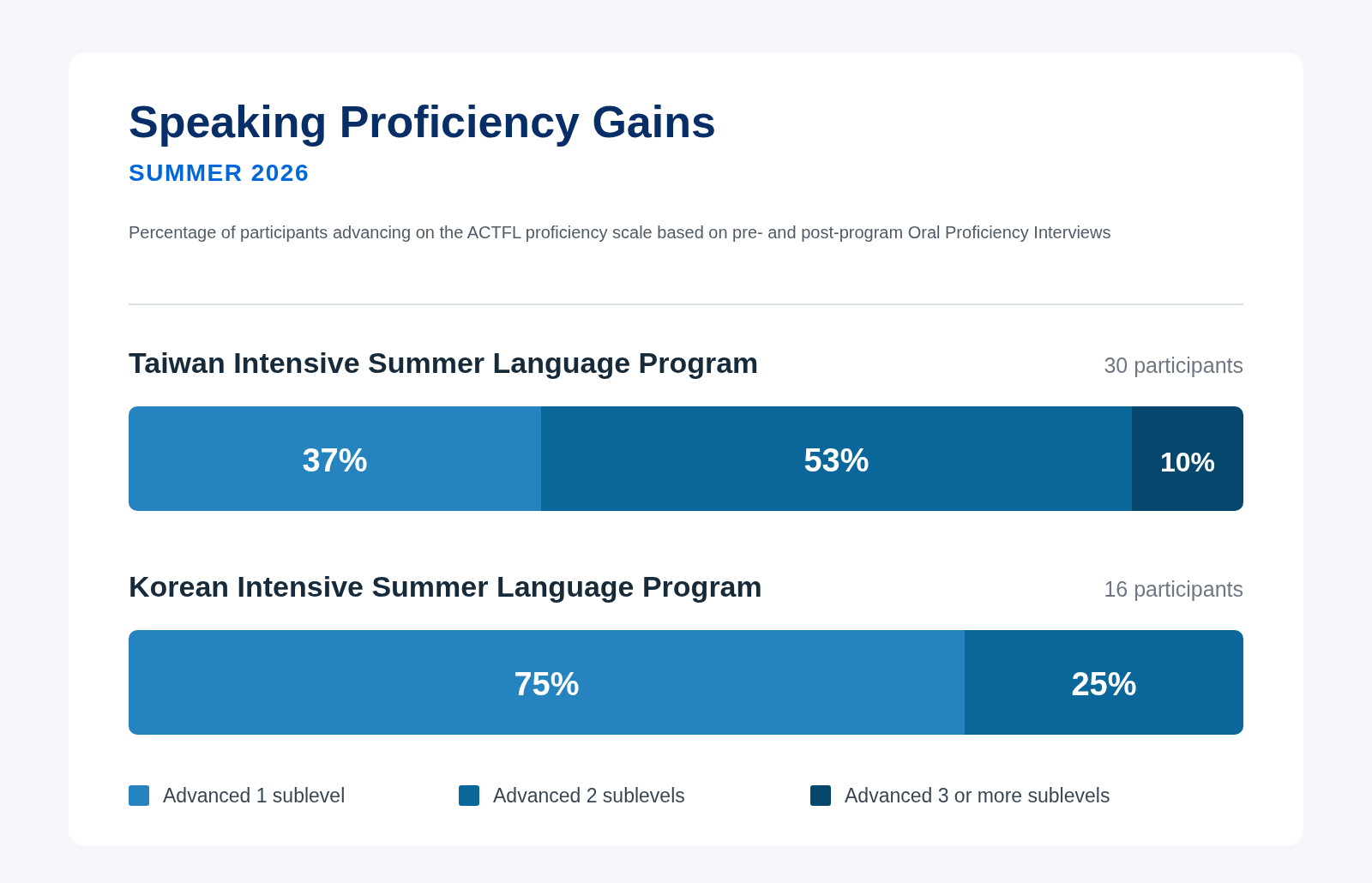
All 46 students participating in the Taiwan Intensive Summer Language Program (TISLP) and Korean Intensive Summer Language Program (KISLP) advanced by at least one sublevel on the American Council on the Teaching of Foreign Languages (ACTFL) proficiency scale during the eight-week programs.
Proficiency in Mandarin and Korean gives Americans direct access to two languages central to U.S. engagement in East Asia. These skills support academic research, diplomacy, national security, and careers in technology, trade, and other fields connecting the United States with the region.
Hosted by Tamkang University in New Taipei City, Taiwan, and Chungbuk National University in Cheongju, South Korea, TISLP and KISLP combine small-group instruction with opportunities to use Mandarin or Korean in everyday settings.
More than two-thirds of participants received scholarships from American Councils or program supporters, including Taiwan’s Ministry of Education Scholarship and the Judith Ehm Foundation Fellowship, helping students and working professionals across the United States access language immersion in Taiwan and South Korea.
To understand the significance of these gains, it helps to consider how language proficiency is assessed. The scale measures what individuals can consistently do with a language in real-world situations. It progresses from Novice to Intermediate, Advanced, Superior, and Distinguished, with the first three levels divided into Low, Mid, and High sublevels.
In just eight weeks, 11 students moved from the Novice range, where speakers generally rely on memorized words and phrases, into the Intermediate range, where they can handle straightforward conversations on familiar topics. Seven students entered the Advanced range, demonstrating the ability to communicate across past, present, and future time frames and navigate complications in conversation.
American Councils conducts speaking assessments before and after each program to measure participants’ progress. The Oral Proficiency Interviews are conducted by an ACTFL-certified tester using the ACTFL proficiency scale, a widely recognized framework for evaluating speaking ability. During the pre- and post-program testing periods, students also complete reading and listening assessments, allowing program staff and university faculty to evaluate their development across additional language skills.
The gains are particularly notable because Mandarin and Korean are classified among the most time-intensive languages for native English speakers to learn. Language Testing International estimates that learners in full-time, small-group instruction generally require hundreds of classroom hours to reach intermediate proficiency. TISLP and KISLP students completed 160 hours of formal instruction over eight weeks, supplemented by homestays with local host families, peer tutoring, and daily opportunities to use the language.
Overall:
- In TISLP, 37% advanced by one sublevel, 53% advanced by two, and 10% advanced by three or more.
- In KISLP, 75% of students advanced by one sublevel, while 25% advanced by two.
“These gains show what is possible when students are challenged to use language purposefully every day,” says Graham Hettlinger, Director of Higher Education at American Councils for International Education. “In just eight weeks, they expanded not only what they knew, but what they could do in their language of study — a testament to their sustained effort and an instructional approach built around active use, consistent feedback, and high expectations.”
Students saw the gains reflected in their academic progress and ability to communicate. One TISLP participant reflected on becoming more comfortable communicating in Mandarin:
My Chinese improved enough to skip an entire year of Chinese study at my U.S. university!
A KISLP participant emphasized how the program created opportunities for sustained learning and growth:
My Korean proficiency is much better than when I started … The program provides you with many opportunities, and if you take these opportunities, there is so much room for growth.
American Councils staff provide on-site support and collaborate with local faculty on pedagogy and program design, creating an environment in which students use the language consistently throughout their program. For language learners interested in making similar gains, applications are now open for upcoming Mandarin and Korean language programs.
Adults ages 18 and older may apply for KISLP’s Summer 2027 program by February 15, 2027; no prior Korean language experience is required. TISLP offers summer, semester, and academic-year programs for applicants who have completed at least two semesters of college-level Mandarin or have comparable proficiency. Applications are due October 15, 2026, for the Spring 2027 semester program and February 15, 2027, for the Summer 2027 program.
Learn more and apply via the American Councils Study & Research Abroad website.